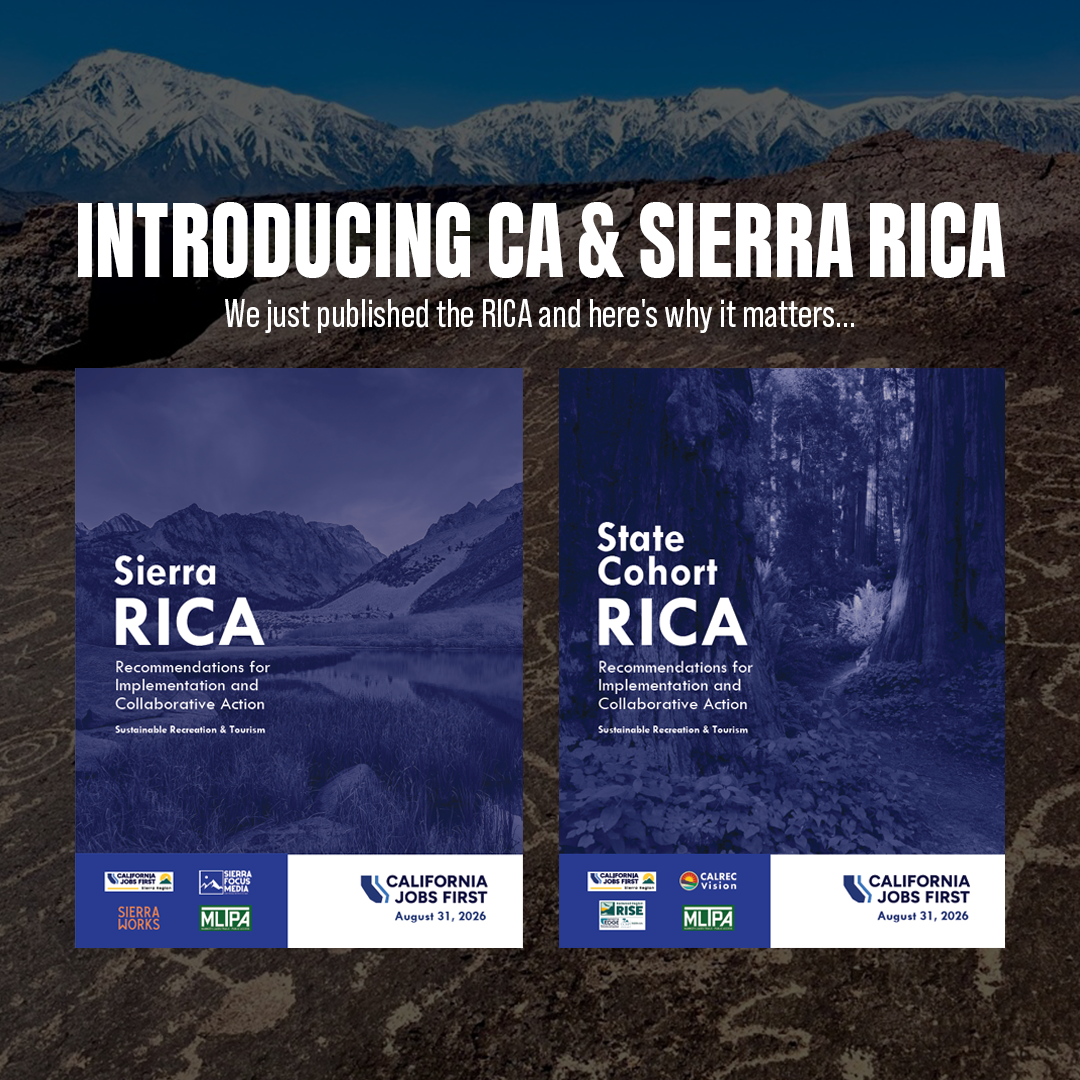
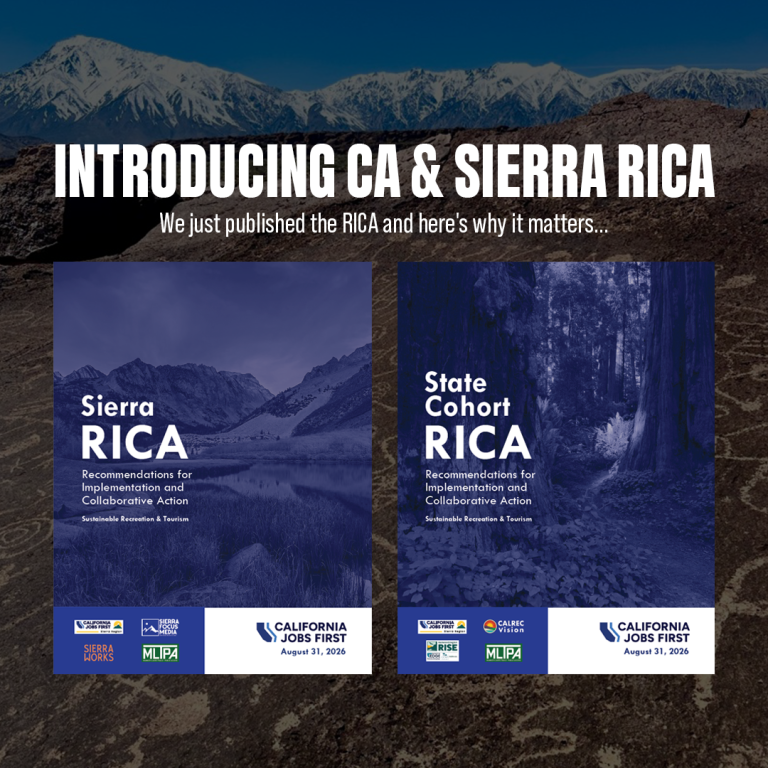
Today we published the two documents that close out our Sierra Jobs First work: the Sierra RICA and the State Cohort RICA.
RICA stands for Recommendations for Implementation and Collaborative Action. If you haven’t spent the last two years inside California Jobs First, the name won’t mean much yet, so here’s the short version. Both documents take what practitioners told us was getting in the way of building sustainable recreation, tourism, and arts and culture projects, and turn it into specific recommendations: who should do what, through which program, to remove the barrier.
Sierra Jobs First was one of 13 regional collaboratives created under California Jobs First, the state’s $600 million effort to build quality jobs and climate resilience region by region. Sierra Business Council convened the seven-county Sierra region. MLTPA and Sierra Focus Media were contracted as the Industry Sector Coordinators for Sustainable Recreation & Tourism, and through Sierra Works we spent the program supporting funded Catalyst projects, tracking down implementation funding, and running the sector’s Working Group.
The Sierra RICA is what that Working Group produced. Between November 2025 and July 2026, practitioners from Alpine, Amador, Calaveras, Inyo, Mariposa, Mono, and Tuolumne counties met eight times, and each session took on one piece of the problem: governance, asset mapping, policy barriers, regional branding and identity, climate resiliency, workforce development, and arts, culture, and placemaking. Each meeting paired a project presentation and interview with facilitated discussion, so the recommendations came out of real projects and the people running them: Catalyst project leads, local government staff, DMOs, land managers, tribal-adjacent organizations, arts organizations, recreation operators, and community leaders. The answers that kept coming back became four Goals and 29 Action Steps:
The State Cohort RICA came out of a parallel effort with a different starting point. California’s Economic Blueprint put recreation and tourism in the “strengthen” category, meaning important but not a priority for direct state investment. Practitioners across the state disagreed with where that left them, so MLTPA and Redwood Region RISE, the Jobs First collaborative on the North Coast, convened a statewide Recreation and Tourism Cohort that met monthly from June 2025 through August 2026. In April, more than 50 of those members traveled to Sacramento for a full-day Symposium of Practice at the California Natural Resources Agency, working from interview summaries of ten Catalyst-phase projects across seven regions. The resulting document organizes its recommendations under eight topics: Assets, Policy & Regulations, Funding, Data, Climate, Workforce, Collaboratives, and Branding & Marketing. Visit California reviewed the draft, and their comments are published alongside the final.
Both documents went through two rounds of open review this summer, each with a companion guide explaining the draft. Reviewers could rate every recommendation and leave written comments, and those comments changed the final language.
Most reports end with a list of things someone should do. A RICA names who, and how. Not “the state should support rural recreation,” but: the Sierra Nevada Conservancy funds collaborative hubs for gateway communities through its existing action plan. The California Arts Council provides technical assistance to get every county to a completed Arts and Cultural Plan. The state reforms grant reimbursement requirements so small organizations aren’t shut out by paperwork. State Parks funds snow play data collection so SNO-Park infrastructure tracks the shifting snowline.
The recommendations are advisory, and the documents say so plainly. But they are written so that an agency program officer, a county supervisor, or a conservancy board member can pick one up and know exactly what is being asked of them and why.
A lot of people showed up for this. Working Group members who joined session after session. Cohort members who traveled across the state for a day in Sacramento. Catalyst project leads who took time away from running their projects to sit for interviews and explain what was making them hard. Reviewers who read a draft policy document in the middle of summer and sent back real critique.
Sierra Jobs First is winding down, but this is the part that was built to outlast it. The recommendations are now with the State of California and the agencies named in them. Everything behind them is archived and public: every Working Group agenda, presentation, recording, whiteboard, and poll result; the full Symposium of Practice documentation, including the project interview summaries and recommendation lab outputs; and a State Cohort Library with regional strategies from all 13 Jobs First regions.
If you work at one of the agencies named in these documents, or you sit on a board that could act on one of these recommendations, the most useful thing you can do is read the two or three Action Steps that touch your program and send them to the person who owns that decision.
Read the Sierra RICA: https://www.mltpa.org/images/downloads/Sierra_RICA_V5.pdf
Read the State Cohort RICA: https://www.mltpa.org/images/downloads/StCoho_RICA_V4.pdf
Working Group archive: https://www.mltpa.org/our-work/sierra-jobs-first-1/sierra-jobs-first/activation-plan
State Cohort and Symposium archive: https://www.mltpa.org/our-work/sierra-jobs-first-1/sierra-jobs-first/recreation-and-tourism-cohort
Thank you to everyone who did the work.
Mat Galvan
Principle/Founder – Sierra Focus Media